For my culminating project in the Seattle Pacific University MEd in Digital Leadership program, I chose to align district needs with the creation of 1 credit cross-disciplinary technology workshop. This work showcases my application of adult learning theory, professional development principles, and International Society for Technology in Education (ISTE) student, teacher, and coach standards.
To determine the topic, district access to technology and current teaching and learning needs were considered. This included devices being made more readily available to students individually, teachers having greater familiarity with technology tools, and the district vision for instruction of technology being used to engage students in rich and meaningful learning experiences. It was also a desire that the course be applicable to different content area teachers. Based on these factors, the topic chosen was problem-based learning (PBL).
To heighten my understanding of the topic I attended a workshop April 17, 2017 at Pacific Lutheran University called Take Thinking Deeper with Digital-Age Project-Based Learning. This session by Suzie Boss, author and Buck Institute educational consultant, focused on transforming traditional instruction to more student-driven and digital. I also thoroughly investigated the Buck Institute for Education (BIE) website, along with a great number of scholarly articles, books, blogs, and videos.
Though this research, I came to the conclusion that teachers need to experience three things to successfully dive into PBL. First, they need to compare and contrast (what PBL is and is not) as it can be confused with project-based learning. Second, they need time to reflect on what experts in the discipline they teach spend their time doing so they can carefully consider how they have their students spend their time. Third, they need to understand that the development of a strong PBL lesson starts with a powerful essential question and be provided time to grapple with this in relation to their current unit plans.
How did I design the workshop? Following the Five Pillars TrainSmart Model by Rich Allen, I located an activity that would serve as the Engage pillar. It is called Draw What you Hear. This activity followed adult learning best practice by being socially interactive, yet low pressure, and intellectually stimulating to clear the mind of distractions and engage participants attention in the PD session. Its nature also served a larger purpose by creating an analogy for the topic. Meaning, each person will take in the idea of PBL differently and their results will be different from yours and that is okay. I came up with this idea on my own.

To Frame (pillar #2) the lesson and create a point of reference, I located a video clip by Sir Ken Robinson that shared some student school engagement statistics. The stats creates a sense of urgency and call to action. This is followed by two slides containing contrasting essential questions for participants to consider. For each, many aspects were evaluated, including the level of inquiry, authenticity, and revisement and reflection created. At this point teachers should be able to self-assess their readiness to PBL. As participants go on break I have them rate themselves on a continuum of PBL readiness. This serves as a formative assessment I can examine over break as the facilitator.

To begin the Explore phase (pillar #3), participants view a video clip that contains a striking statement for inquiry and reflection. It poses the question: what tasks do experts in your discipline spend the majority of their time doing? I model reflection with an example of an architect and then, paying attention to adult learning practices, allow participants to take ownership of their own learning by inviting them to work collaboratively or privately and reflectively on what they currently ask students to do in their classroom in contrast to an expert in their discipline. This activity tightly aligns with ISTE Coaching Standard ‘2c’, where the coach pushes the teacher to have students assume professional roles, research real-world problems, collaborate with others, and produce products that are meaningful and useful to a wide audience. Teacher participants share their reflections via a Google Classroom question which models ISTE Teacher Standard 3, Model Digital Age Work and Learning.
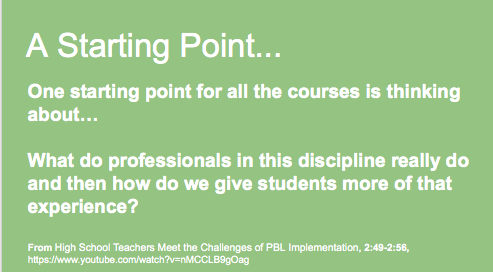
After a debrief, some participants should be ready at this point to explore their own question. However, I do not not push them to do this yet. This is because I think they need more scaffolding. If I truly want them to be able to create an environment conducive to students being constructors of knowledge (ISTE Student Standard #3) they need more guidance. To provide this support, I previewed, curated, and categorized numerous video examples of teachers talking about their practice into subject areas. Teachers are invited to browse their subject area and also to browse the project database on the BIE website. Some of the videos crossover between subject areas. This is good because it shows the natural interdisciplinary nature of PBL. Again, this offers choice, autonomy, and relevance to the adult learner. At the same time, it asks teachers to implement ISTE Teacher Standard 2, Design and Develop Digital Age Learning Experiences and Assessments. In particular, it speaks to indicator ‘b’ by allowing active participation in their own learning. Teachers are also encouraged to search Google and YouTube for additional examples.